 English
 Español
 Français
 Português
 Deutsch
 Italiano
 Русский
 العربية
 简体中文
 香港中文
 한국어
 日本語
 Türkçe
 Nederlands
 Bahasa Indonesia
Export Cost Begins With Formula Design
International composite deck orders are often priced from a simple board specification, yet the commercial result depends on the formulation behind it. As a WPC formulation development engineer, I assess wood fibre species, polymer grade, filler loading, stabiliser package, processing temperature and expected service life before setting a target cost. A decking board that is inexpensive at the factory gate can become expensive for an importer if it warps, fades, absorbs water or generates installation complaints.
The practical question is not only how much composite deck cost, but what performance that cost secures over ten or twenty years. Export buyers compare the purchase price with container utilisation, local labour, replacement risk, warranty exposure and market positioning. A formula must therefore provide repeatable quality at a controlled material cost, while remaining suitable for the climate, building standards and installation methods of the destination market.
Wood Fibre and Plastic Ratio
Wood fibre gives WPC decking its visual character, stiffness and tactile warmth. It also reduces polymer consumption, which can improve cost efficiency when the fibre is properly dried, screened and treated. Higher fibre content is not automatically better. Excess fibre increases moisture sensitivity, raises melt viscosity and makes the profile more vulnerable to swelling, edge damage and surface defects. Fibre particle size and distribution matter as much as the percentage shown on a technical sheet.

Polymer provides cohesion, water resistance and process stability. Polyethylene is widely used for outdoor decking because it offers impact resistance and practical extrusion behaviour, while PVC and polypropylene can suit other product requirements. A formulation with too little plastic may look attractive in a laboratory sample but fail during profile welding, screw fixing or thermal cycling. For export production, I normally balance fibre and polymer against board geometry, reinforcement needs and local weather rather than applying one fixed ratio to every order.
Additives That Protect Service Life
Additives determine whether a formula continues to perform after years of ultraviolet exposure, rainfall and repeated heating and cooling. Coupling agents improve adhesion between hydrophilic wood fibre and hydrophobic polymer, increasing strength and reducing internal voids. Lubricants help the compound pass through the extruder and maintain surface quality, but excessive lubrication can reduce bonding and create a weak, waxy finish.
Outdoor grades also require carefully selected antioxidants, ultraviolet stabilisers, pigments, fungicides where appropriate and moisture-control measures. The package should match the export destination. A dark board in a high-solar region may need stronger colour and heat management than a pale board sold in a mild northern climate. Testing should include water absorption, flexural strength, impact resistance, colour change, slip performance and accelerated weathering. These results give sales teams credible technical evidence instead of relying on appearance alone.
Formula Choices Across WPC Product Lines
Decking normally demands a balance of stiffness, slip resistance, drainage and dimensional stability. Wall cladding may require lower weight, better fire performance or a surface designed for vertical installation. Fencing needs resistance to wind load, screw pull-out and repeated handling, while pergolas and landscape products often need greater section strength and stable colour on exposed faces. The same base compound can support several product families, but die design, skin formulation and reinforcement should be adjusted for each profile.
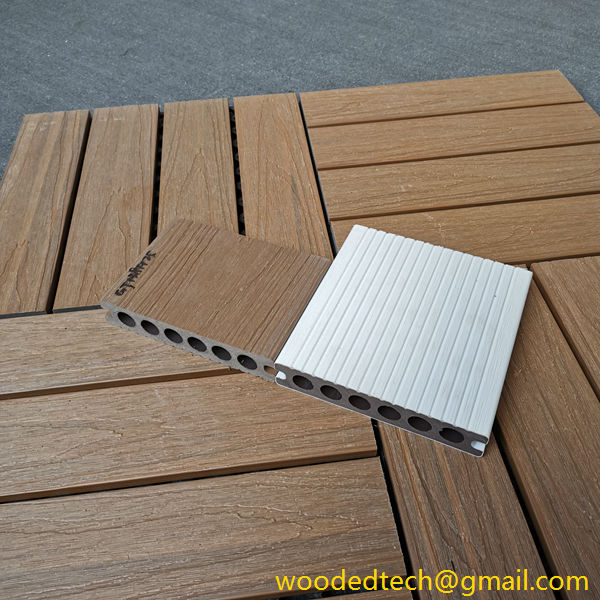
Co-extrusion can control cost without reducing the performance of the entire section. A durable outer layer can contain a higher stabiliser and pigment concentration, while the core uses a more economical formulation with recycled polymer or controlled filler content. This approach is useful for export orders that require premium appearance but remain price sensitive. It also helps factories offer several quality grades without creating completely separate material systems and inventory risks.

Cost Control for International Orders
Material purchasing is only one part of the export calculation. Moisture in fibre increases energy use and can cause production stoppages. Inconsistent recycled polymer creates colour variation and unstable extrusion. Poor packing damages board edges, while inefficient profile dimensions waste container space. I evaluate formulation yield, extrusion speed, scrap rate, packaging density and expected claims alongside the raw material quotation.
A reliable export specification should state fibre percentage, polymer type, density range, colour tolerance, mechanical targets, weathering expectations and acceptable surface variation. Samples must be tested from production batches, not only from development compounds. This discipline allows a factory owner, quality supervisor and international sales manager to quote with greater confidence. It also gives the buyer a clear basis for comparing a lower-priced board with a higher-performance alternative.
Long-Life Products Strengthen Export Value
The strongest international orders are built around predictable service life. A decking formula that lasts longer can justify a higher initial price when it reduces replacement, maintenance and after-sales costs. Clear installation guidance is equally important because inadequate joist spacing, poor ventilation or incorrect fasteners can cause failures that are blamed on the material.
For this reason, formulation development should work with extrusion, mould design, inspection, packaging and technical service teams from the start. A well-designed WPC product protects its colour, shape and fastening performance through realistic outdoor exposure. That combination gives exporters a defensible cost story: the buyer is paying for controlled raw materials, efficient production and dependable performance across decking, cladding, fencing, pergolas and landscape applications.