 English
 Español
 Français
 Português
 Deutsch
 Italiano
 Русский
 العربية
 简体中文
 香港中文
 한국어
 日本語
 Türkçe
 Nederlands
 Bahasa Indonesia
Start with the Finished Deck Area
Accurate board quantities begin with the dimensions of the area that will actually receive decking. Measure the length and width in metres, then multiply them to calculate the area. For a rectangular deck measuring 5 metres by 4 metres, the surface area is 20 square metres. Divide an irregular layout into simple rectangles, calculate each separately and add the results. Exclude steps, planters and openings that will not be covered by boards.
Area alone does not determine the order quantity, however. Board width, the gap between boards and the direction of installation all affect coverage. Buyers searching for “how many composite deck boards do i need” should provide a supplier with a dimensioned plan, rather than relying on a square-metre estimate. A reliable manufacturer can check the calculation against the proposed product dimensions and installation method.

Calculate Coverage from Board Dimensions
For a first estimate, use the board’s effective coverage width: the visible board face plus the specified installation gap. If a board has a 140 millimetre face and the recommended gap is 5 millimetres, its effective width is 145 millimetres, or 0.145 metres. When boards run along the 5 metre side of the example deck, each row covers 5 metres in length. Across the 4 metre width, 4 divided by 0.145 gives approximately 27.6 rows, so the layout needs 28 rows.
Multiply the number of rows by the board length required for each row. If the selected product is supplied in 5 metre lengths, the simple layout uses 28 boards before allowance for cuts, damage or future repairs. This method assumes boards span each row without joints and the deck edges suit full-width boards. Where board lengths, decking direction or edge details differ, the supplier should prepare a cutting plan. Confirm whether stated board width means the face width or the effective installed coverage; confusing the two can cause a costly shortfall.
Allow for Cuts, Layout and Product Details
Waste depends on the shape of the deck, not on a universal percentage. A straightforward rectangle with boards running in one direction may need a modest allowance, while angled edges, borders, picture-frame details, diagonal patterns and numerous cut-outs can generate substantially more offcuts. Ask the installer or supplier to estimate waste from the actual drawing. For a simple project, buyers often add around 5 to 10 per cent as a planning allowance, but this should not replace a layout-specific calculation.
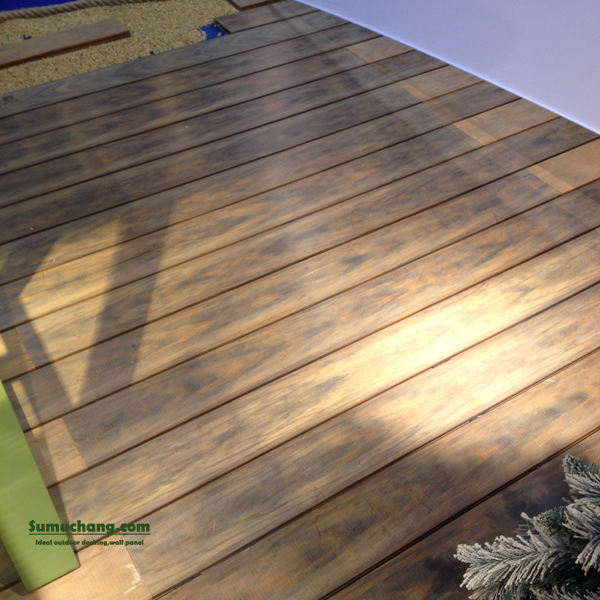
Check the product’s usable length and manufacturing tolerance, as well as the installation instructions. Some boards have end profiles or connection details that affect usable coverage. Confirm the required joist spacing, clip type, end-to-end expansion gap and perimeter clearance for the destination’s climate. Temperature changes can affect composite boards, and installation guidance may vary by profile. A mismatch between the quoted board and the tested installation system can create movement, uneven surfaces or rejected inspection results.
Evaluate the Supplier and Confirm Specifications
From a Chinese WPC manufacturer’s sales perspective, quantity accuracy is only one part of a dependable purchase. Overseas buyers should assess whether a supplier controls production or acts only as a trading intermediary. Request current factory photographs or a live production review, and ask about extrusion capacity, profile tooling, colour control, inspection records and packaging. Verify that the company can provide traceable specifications and consistent production batches. Independent test reports should identify the tested product and method, rather than making broad claims about every item in a catalogue.
Before paying a deposit, approve a written specification covering profile dimensions, colour, surface finish, material composition where relevant, board length, tolerances, accessories, packaging and order quantity. Request physical samples and compare them with the approved colour reference; photographs cannot reliably show colour or texture. Clarify whether the quote is based on net board quantity or includes spare material, and ask the supplier to show the calculation and cutting assumptions. For custom colours or profiles, confirm sample approval, tooling charges, minimum order quantity and production lead time in writing.
Plan Ordering, Shipping and Installation Together
International orders require attention to carton quantity, bundle dimensions, gross weight and container loading. Ask for a packing list estimate before production so the freight forwarder can check shipment volume and destination handling requirements. Specify how boards and clips will be protected against abrasion, moisture exposure and movement during transit. Agree how short shipments, transit damage and colour variation will be documented and handled. Retaining a small number of boards from the same batch can help with later repairs, particularly when the product is installed outdoors and exposed to weathering.
Have the supplier or installer review the final site measurements, board direction and edge details before the order is released. Changes to the layout after production can leave unusable lengths or require an urgent replacement shipment. A clear drawing, approved sample, confirmed installation guidance and transparent quantity calculation make purchasing more predictable for distributors, contractors and project owners. The right number is not simply the area divided by a nominal board size; it is the quantity that fits the real layout, the specified product and the shipment plan.